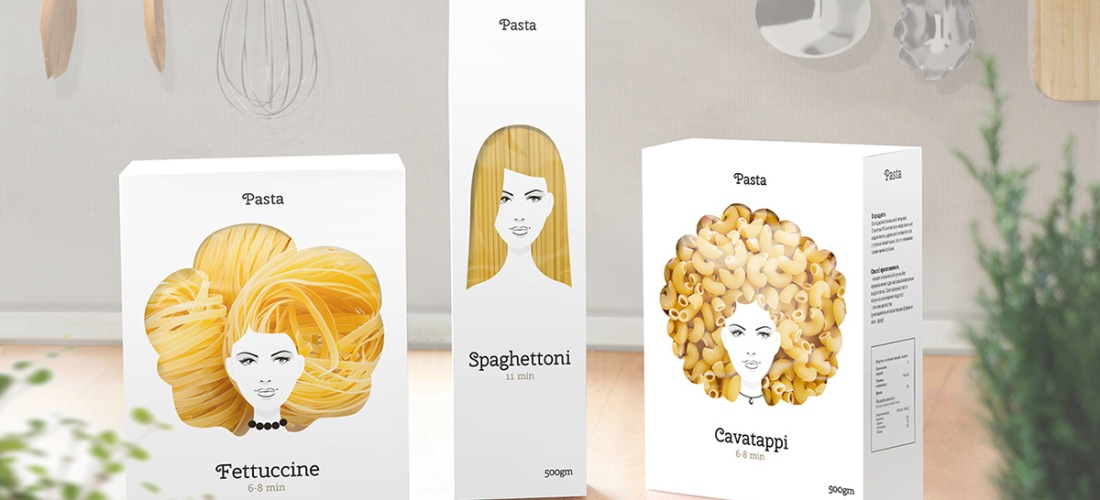
I came across this pasta packaging on Pinterest. These packages are designed by Moscow-based designer Nikita Konkin. He used a minimalist design approach to pasta packaging, and as a result, makes them stand out against other pasta packaging on the shelves. His concept was to let people see parts of the product itself, and that to in a fun and interesting way, incorporating the different pasta shapes. I found these packages to be fun and innovative. They really are one of a kind. They show what pasta you’re getting, the cooking time, and instructions clearly. The black and white box really stands out against the pasta color. The typeface Konkin chose also reflects the playfulness of the box and the pasta shapes, as well. Along with the pasta shapes, the texture of the pasta makes it actually look like hair. I guess the display cut-out helps the consumer to get the image of hair, too. I can’t find anything to change about these packages. Konkin has successfully designed pasta packaging that isn’t like the rest of the pasta packaging that already exists.
This morning I woke up with a craving for a veggie burger and a milkshake from Burgatory. So later this afternoon, I satisfied my hunger and was surprised to see Burgatory’s take-out packaging. In case you haven’t realized it yet, I ordered my burger and milkshake to go. The whole Burgatory brand was created and designed by Wall-to-Wall Studios (W|W). They’ve been around for almost 24 years now and have offices here in Pittsburgh and in Honolulu. For Burgatory, W|W decided to “[design] an integrated branded experience that elevated every touch point, including the food, to become the hottest restaurant in the region.” Burgatory’s designed elements include: the visual branding (logos and taglines); the on-site accessories (menus, gift cards, and take-out packaging); and the environmental details (signage and wayfinding) (Wall-to-Wall Studios). Wall-to-Wall Studios’ concept/idea for Burgatory was to be “wit[ty] and [have] just the right amount of irreverence to be remembered and craved.”
Now what I’ve always liked about Burgatory was their use of different typefaces that are just so in your face! They really have a fun time with typography! So today, when I saw the to-go packaging, I was amazed by how they enhanced a simple cardboard box and a paper bag. Both elements are mostly type heavy, but also integrate some imaging and simple icons. The typography and the icons are red and that really appeals to a person’s hunger and pops out on the box and bag. The take-out packages also feature witty headers and sayings using loud typefaces and really appeal to a person’s humorous side as well. Along with being loud and red, the typefaces have a grungy look and feel to them. This visual style works well with the textures of the box and paper bag and further enhances them. The type is also strategically placed out in different positions on the box. This makes them visually interesting and allows you to move your eyes around on the box and on the bag. On the whole, the packaging is rememberable and witty like the concept stated. It entices to an audience with their humor and the most importantly, their hunger.
Their take-out packaging is working very well for them. Like with all of their other design elements, Burgatory is appealing to people with an appetite and a humor. They leave the audience with wanting more to eat, and as result, wanting to come back time and time again. The brand itself communicates well as a burger and shake bar. In my opinion, Burgatory’s branding and identity really makes it “sinfully good.”
P.S. “Sinfully good” is one of their taglines if you didn’t know that 🙂
So I was doing some grocery shopping one day and I was walking around the frozen food aisles when I caught a glimpse of some food packaging that reminded me of the former Mexican restaurant, Chi-Chi’s (I miss their food!). I back tracked my steps and took out the box. The food packaging was for Padma Lakshmi’s Easy Exotic frozen food line. What caught my in the first place was the photograph of the rice dish (spicy black beans and rice). It wasn’t the signature of Lakshmi or even her face. It was the food itself and right in the left corner was second most important information I saw: vegan. So it was a no-brainer for me then to buy it!
When I examined the packaging again, I noticed several things. Straight off the bat, I understood that this package was to appeal to foodies anywhere in the US. However, I couldn’t really get whole exotic concept from the packaging. Yes, the bright blue color and the pattern seem exotic, but they really aren’t screaming exotic to me. As a result, it was hard for me to get the intended message. The whole box looked and felt homemade the wooden texture and the handwritten looking content. I felt that most well designed part of this box, aside from the front, was the back panel. The content and images were laid out nicely and allowed the white space to move my eyes across the box easily. I also noticed that the box used at least four different typefaces. The box had an old style serif typeface (dish name), a humanistic sans serif typeface (“Padma’s,” cooking instructions, and story), and I what believed were two casual script typefaces (“Exotic Easy” and handwritten looking content). There was a consistent placement and use of one of the casual scripts, the old style serif, and the humanistic sans serif on the back panel and the side panel with the cooking instructions on it. This subtlety displayed some text hierarchy on the side panel and back. In addition to that, I noted that two of the panels lacked some sort of design element. Overall, this box did some nice things with typography and layout design and it most definitely attracted a food-loving audience. However, I would change some things on this package to make it work with the concept more.
I would use more floral patterns and incorporate more splashes of color to enhance the package’s exotic concept. Right now it emphasizes too much on Lakshmi’s homemade experience and not enough on the exotic part of the food. I would also change the amount of typefaces this packaging used. Instead I would stick to one serif typeface for any of the headings and one sans serif typeface for any of the other written content. I would let the handwritten elements stay on the packing because it adds a personal element to the packaging. Finally, I would move the nutrition facts from the one side panel to the bottom panel with the barcode on it. I would then design this side panel to have a similar layout like the other one and have more written content on it. Or maybe, that entire panel could have Lakshmi’s little note on it, instead of on the back. This would allow the back have more white space and the note to make more breathing room. I think this redesigned package would appeal more to food lovers.
*Padma Lakshmi’s Easy Exotic food packaging is branded and designed by Brandmade Design Co. (http://brandmadeby.us)
Back
Side 1
Side 2
Bottom
Photographs taken by Akaashmi Mishra; Feature image from Google Images


 Akaashmi Mishra